Product Strategy for Complete Products, Components and Features
By Marcus Adolfsson · Published January 29, 2026
A Practical Guide for Product Owners and Product Managers
Product Strategy for Complete Products, Components and Features
If you’re a product owner or product manager, you’ve probably felt it:
Endless feature requests from stakeholders
A roadmap full of “stuff” but no clear story
Teams shipping a lot, but impact is… unclear
That’s where a product strategy earns its keep.
This post is an introductory guide to product strategy for product owners, product managers and anyone working with roadmaps and features.
We’ll connect business strategy, product strategy, and the day-to-day work of teams, and we’ll talk about why regular reviews and pivots are not a “nice to have” but essential.
Start With Why: Product Strategy as Your Cathedral Story
Simon Sinek’s Start With Why popularised a simple truth:
People don’t buy what you do, they buy why you do it.
Think of the classic cathedral story:
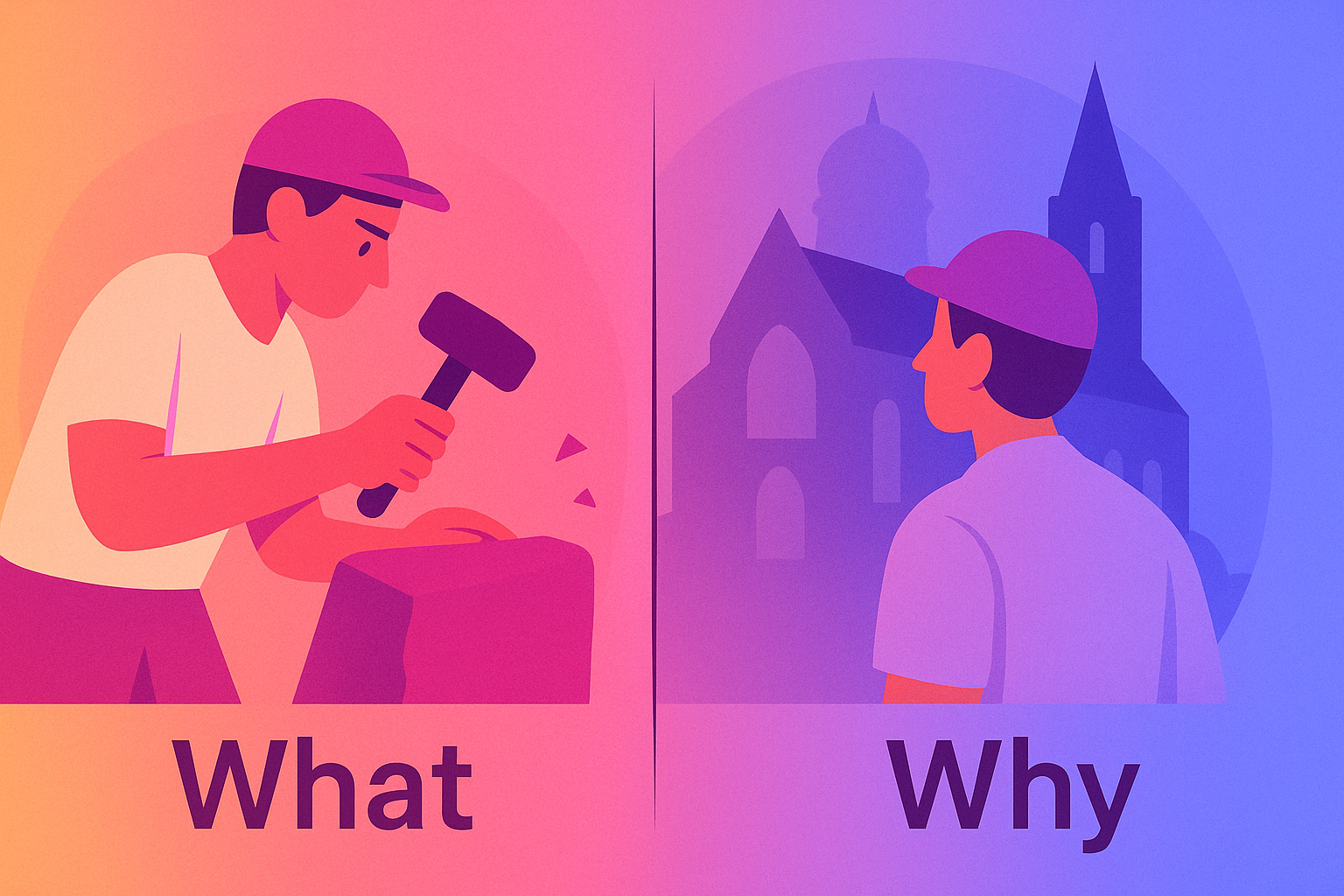
“I’m cutting stone.”
A worker wihtout passion
“I’m building a cathedral
A worker that understands the Why
A good product strategy makes everyone in your product organisation feel like the second worker.
Before you talk about what to build or when, your product strategy has to answer:
Why does this product exist?
Why does it matter to our customers, our business, and our market?
If your team can’t answer “Why are we doing X?” in one or two sentences, your product strategy is either missing, outdated, or not communicated.
Product Strategy for Product Owners: Connecting Business Strategy to Roadmaps
Your product doesn’t live in a vacuum. It lives inside a business strategy.
A business strategy (think Playing to Win) typically answers:
CHALLENGE
What are we up against? What’s the problem, trend or tension in the market?
MARKET – (Where will we play?)
Which customers, segments, geographies, channels?
WIN – (How will we win?)
What is our competitive advantage? Cost, differentiation, focus?
CAPABILITIES
What must we be really good at to win?
ACTIVITIES
What systems, processes and ways of working make those capabilities real?
A product strategy mirrors this, but at the product level:
It must support the business “how we win”.
It must be obsessed with users and their problems.
It must translate business choices into product choices.
For larger products or platforms you’ll often have:
One overall product strategy
Plus lighter product strategies for:
Product areas or modules
Components (e.g. search, identity, payments)
Even important APIs or feature clusters
Same logic, different zoom level.
Connecting the Dots: From Problem to Features
A good product strategy connects everything between “we see a problem” and “we built this feature”.
Here’s a structure that works well:
Problem Statement / Opportunity – Current State of Play
Vision
Mission
Objective
Strategy & Key Results (KRs / Goals)
Themes of Work / Product Areas / Opportunities
Initiatives (Tactics, Epics)
Features
Let’s merge that with some common strategy terms:
Vision / Mission
This is the long-term picture at the very top of the stack. It describes what the world looks like if your product truly succeeds – the cathedral you’re building, not the stones you’re cutting.
Objective
Objectives translate the vision into a small set of concrete outcomes. They describe what must be true in 1–3 years for you to believe you’re on track toward the vision.
Strategy & KRs
(bridge between “Why” and “What/When”)
These are your big bets and focus areas: how you intend to reach each objective. In the image, each “Strategy / KR” block sits under the objectives and is paired with a handful of key results that show whether the strategy is working.
Pillars / Themes of Work
Each pillar or theme is a major area of work that supports a strategy. In the diagram, they sit directly under the strategies and group related problems and opportunities (e.g. “Onboarding”, “Payments”, “Reporting”).
Initiative / Opportunity
Within each pillar, initiatives are the specific opportunities you choose to pursue. They’re substantial chunks of work (often epics) that move a metric or KR, such as “Guided onboarding”, “Self-serve setup”, or “New pricing experiment”.
Features
Features are the shippable units of value that users actually touch. In the image, they’re at the base of the stack: the tangible changes that deliver on an initiative and solve a specific user problem.
Goals / KRs
(embedded through the structure)
While they’re visually paired with the “Strategy” layer, KRs and goals are what you attach to objectives, strategies, and sometimes even initiatives. They’re the numbers that tell you if each layer is working.
Roadmap
The roadmap doesn’t add new content; it shows when you intend to work on the pillars, initiatives and features. In the graphic, the bracket on the right highlights that the roadmap is the time-based view of how you prioritise and sequence those blocks over quarters or releases.
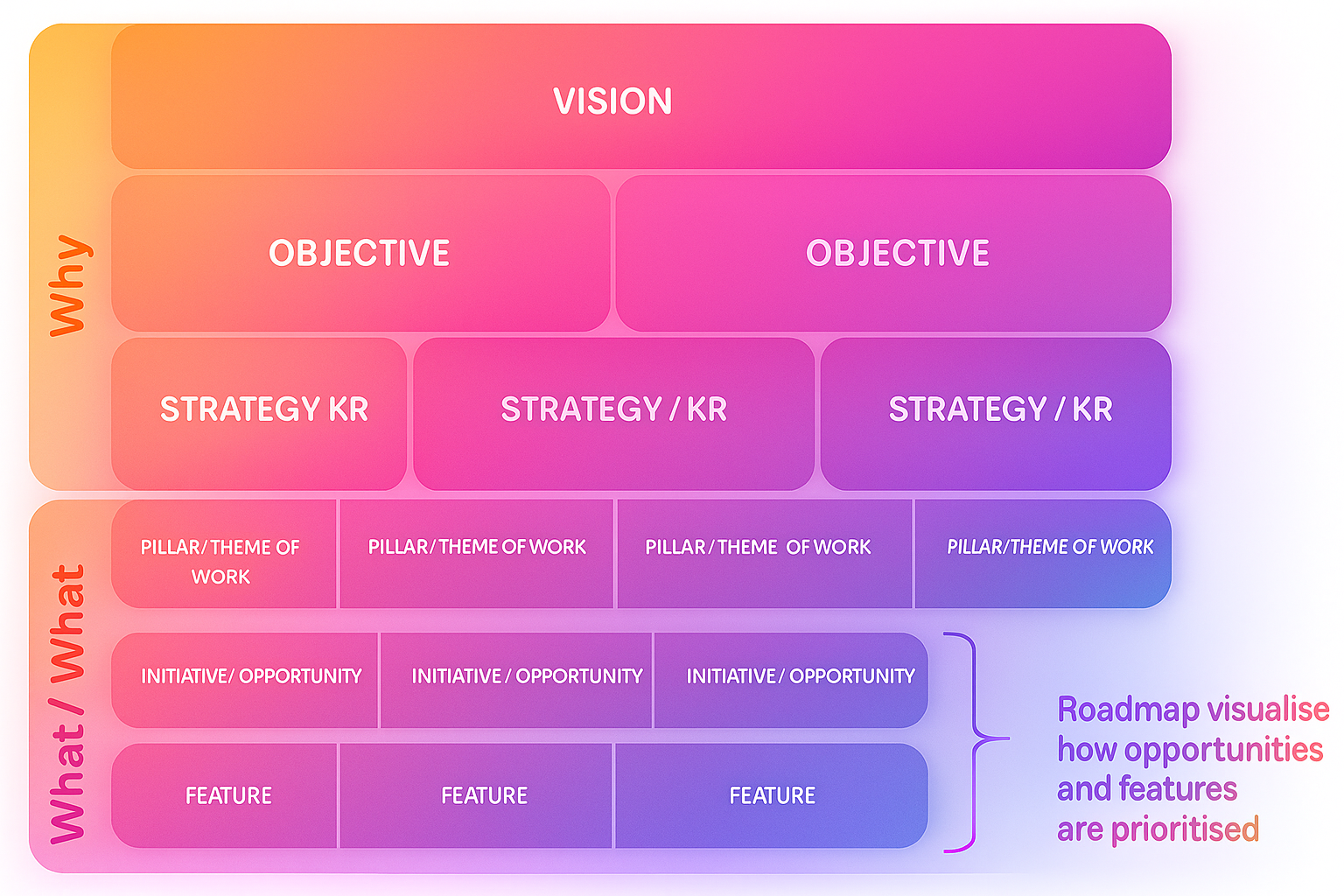
If you can’t trace a feature upwards through this chain back to a clear challenge and vision, that feature is a candidate to remove or re-think.
Describing the Product: Challenge, Market, Win, Capabilities, Activities
When you write a product strategy for a complete product, a component, or even an API, you should be able to describe it across five dimensions.
CHALLENGE – What are we up against?
What are customers struggling with today?
What’s broken in the current experience, process, or market?
What trends, regulations or technologies are changing the game?
How do our internal constraints (tech debt, skills, governance) shape the challenge?
This is where continuous UX and user research comes in: support tickets, call listening, usability tests, analytics, interviews, field visits.
MARKET – Where will we play?
Who are our target users and customers?
Which segments are in scope, and which are deliberately out of scope?
Are we playing in an existing “red ocean” or creating a new blue ocean space
What channels matter (web, mobile, APIs, partner integrations)?
If your product serves several segments, it’s often worth creating a lighter sub-strategy per segment or product area.
WIN – How will we win?
Are we competing on cost (simpler, cheaper), differentiation (better experience, unique proposition) or focus (deep value in a niche)?
Why would a user choose us over the status quo or competitors?
Which jobs-to-be-done do we serve better than anyone else?
This is where your product strategy and business strategy meet.
If the company wants to win through, say, “premium, high-trust service,” your product strategy should not rely on “lowest price and self-service only”.
CAPABILITIES – What must we be great at?
Do we need world-class search/recommendation?
Do we need deep compliance and auditability?
Do we need near real-time analytics, offline support, or localization?
What kind of UX, research and product discovery muscles do we need?
These capabilities then translate into hiring, tooling, and platform decisions.
ACTIVITIES – What must we actually do?
What management systems do we need? (OKRs, experimentation, design reviews, incident management)
What processes are needed to keep the strategy alive? (research cadence, roadmap reviews, stakeholder syncs)
How do we measure and update our product strategy?
This is often where junior product folks feel “stuck in JIRA”.
Your job as a product owner is to connect those activities back to the strategy.
Product Strategy for Product Owners: From Strategy to Day-to-Day Work
A product strategy is only as good as the work it creates.
You should be able to say:
This feature exists because it supports this initiative, which supports this opportunity, which supports this strategy pillar, which exists to achieve this objective, which moves us towards our product vision and business strategy.
Concretely:
Objectives / Goals / KRs – Define what success looks like (e.g. “Increase activation rate from 30% → 50%”).
Strategy Pillars – Example: “Make onboarding effortless for first-time users”.
Opportunities / Themes – Example: “Reduce friction in signup”, “Help users self-serve setup”.
Initiatives / Epics – Example: “Guided onboarding flow”, “Interactive setup checklist”.
Features – Example: “Progress tracker component”, “Recommended next step banner”.
Roadmap – Shows when initiatives roughly happen (quarterly), the confidence levels and dependencies. The roadmp updated as we learn from UX research, usage data and experiments.
If your roadmap just says “Feature A, Feature B, Feature C”, you’re missing the strategic story.
Knowing Your Customers: Why Continuous UX Reviews Are Non-Negotiable
You cannot write a meaningful product strategy from behind a spreadsheet alone.
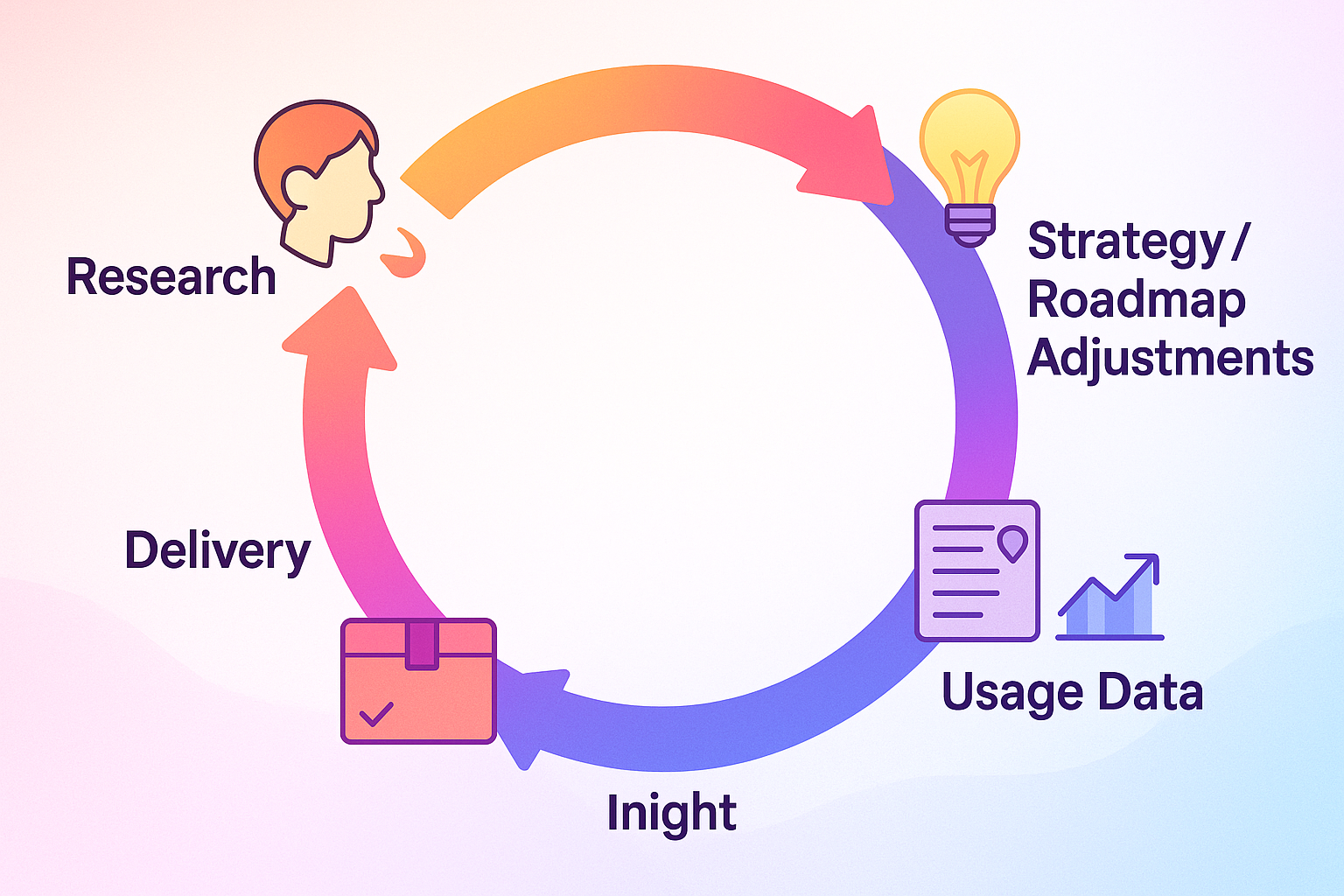
To make sure your strategy truly reflects real customer needs and pain points, you need:
Continuous UX research: usability tests, user interviews, surveys
Regular support and sales reviews: what patterns show up in tickets and deals?
Usage analytics: where do users drop, succeed, or hack your product?
Field observation (if possible): see how your product works in the real world
This does three things:
Validates whether your diagnosis of the challenge is still correct
Shows if your “how we win” is actually resonating with users
Reveals new opportunities and areas where your product strategy may need to pivot
As a product owner, you don’t own research alone, but you own making sure it happens and that it shapes the strategy.
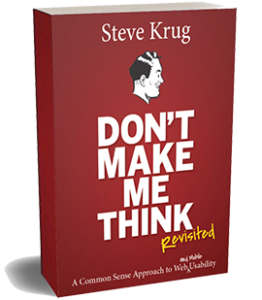
UX reading tip: If you’re new to UX or want a sharp refresher on how people actually use digital products, Don’t Make Me Think by Steve Krug is a fantastic introduction.
It’s short, practical, and captures the core mindset: reduce friction, respect users’ time, and make your product obvious to use.
If you’re short of time, or just want some further guidance, please reach out and we can discuss how Luminbrane can help you bring UX thinking directly into your product strategy and roadmap.
Product Strategy as an Iterative, Collaborative Process
A product strategy is not a genius document written alone and thrown over the wall.
It’s a collaborative, iterative process with the wider:
Product team (PMs/POs, UX, engineering)
Impacted teams (support, marketing, sales, ops, compliance, etc.)
Stakeholders and leaders
A simple process you can use:
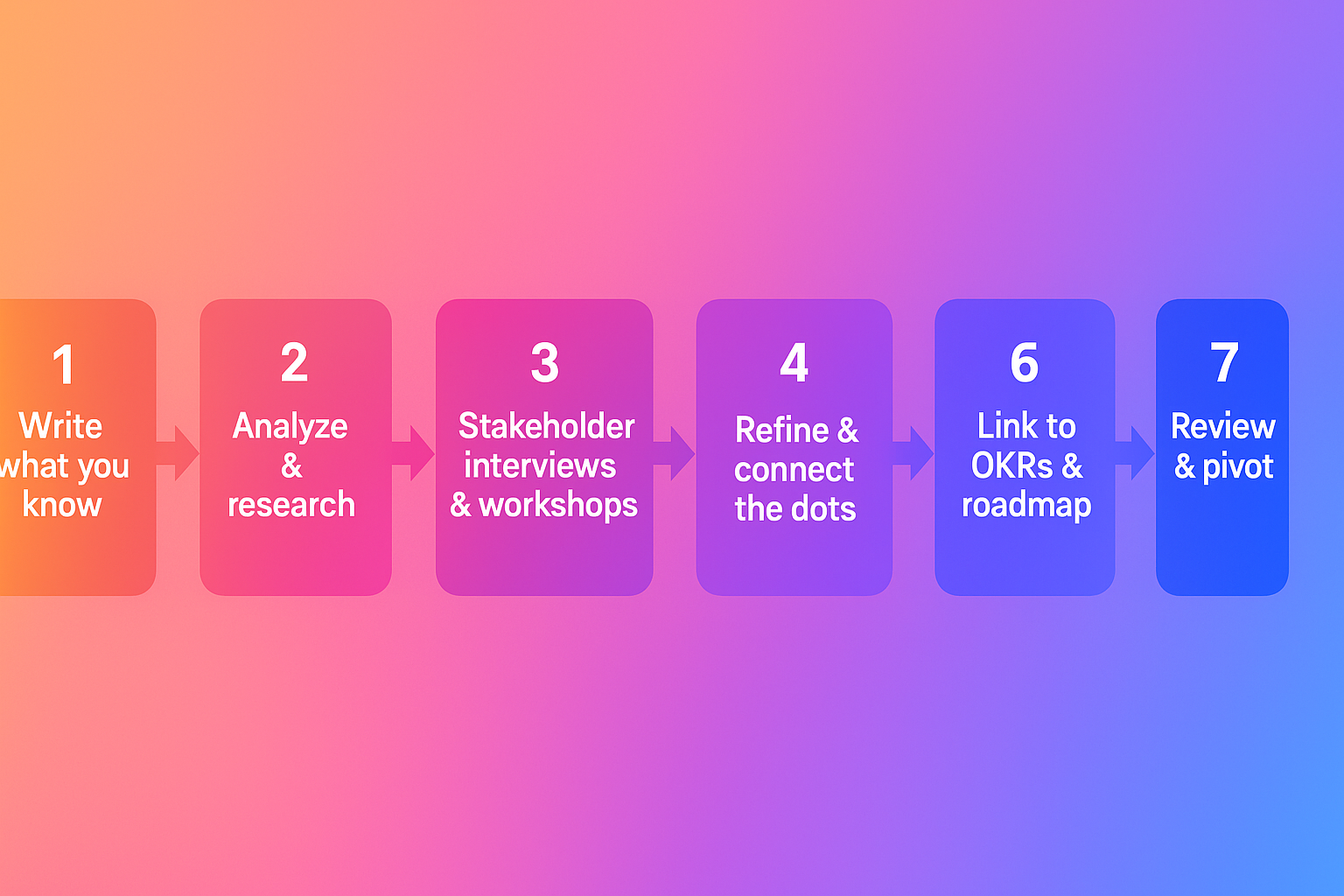
Write down what you know today – STRATEGY DRAFT
Draft your current understanding of challenge, market, vision, objectives, and key bets.
Don’t aim for perfection, aim for a clear first version.
Do focused analysis – ENRICH
Market & competitive scan
Customer segments (who we really serve)
Support reviews, interviews, usability tests
Existing internal & external data (usage analytics, NPS, CSAT, churn)
Stakeholder interviews & team workshops – ENRICH AND VALIDATE
Ask leaders: “What does success for this product look like in 2–3 years?”
Ask teams: “Where do we see friction and opportunity in the current product?”
Align on constraints (budget, tech, regulation).
Refine and connect the dots – REFINE
Update the strategy document:
Problem → Vision → Mission → Objectives → Strategy Pillars → Themes → Initiatives → Features.
Check: can we trace each element back to the business strategy and customer problem?
Timebox and publish a “Version 1.0”
Set yourself a clear deadline (e.g., 2–4 weeks).
Don’t wait until it’s “perfect” – agree on a version and communicate it widely.
Use a simple one-pager and a slide or two to share with teams and stakeholders.
Link it to your OKR and roadmap cycle
Revisit the product strategy at least every quarter (OKR rhythm).
Adjust goals, themes and initiatives based on what you’ve learned.
Use roadmap reviews to check alignment:
“Does this roadmap still reflect our product strategy?”
“Has reality changed enough that we need to revisit the strategy itself?”
Continuously update, don’t continuously rewrite – UPDATE
Small adjustments: tweak KRs, priorities, timelines.
Bigger changes: when the challenge, market, or “how we win” changes, that’s when you might pivot.
Applying Strategy at Different Levels: Products, Components and Features
For large products, a single monolithic strategy often becomes too abstract as the overall product strategy, Defines the big “Why & How we win” for the whole product. Therefore, for large products it can be valuable to define small, more actionable product strategies for parts of your products, often referred to as product area, product component.
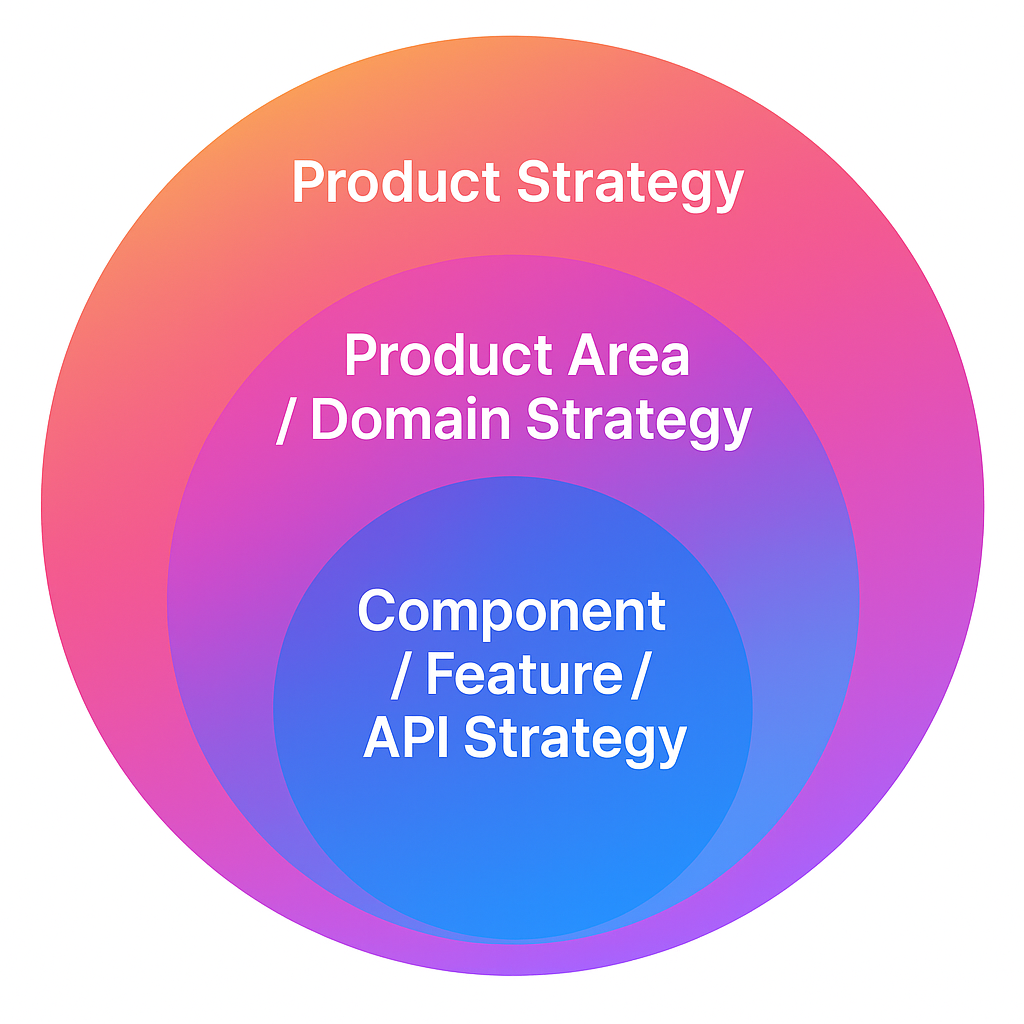
Product area / domain strategies
Example: “Onboarding”, “Payments”, “Search & Discovery”, “Reporting”. Each has:
Its own problem/opportunity statement
A mini vision and objectives
Strategy pillars and themes
Component / Feature / API strategies (lighter)
Shorter, more focused strategy docs or one-pagers. Useful for:
Critical components (e.g. “identity and access”, “menu engine”, “game discovery API”)
Features that have strong business impact or complexity
Same pattern, just compressed:
Challenge → Vision → Objective → Approach → Success metrics → Key initiatives
You get the benefit of clear local decision-making, while still staying connected to the overall product and business direction.
Keeping Your Product Strategy Alive: Reviews, Pivots and Learning
A product strategy that never changes is almost certainly wrong.
You should regularly ask:
Is our problem diagnosis still correct?
Have our customers’ behaviour or needs changed?
Has the market, regulation, or technology shifted?
Are our bets paying off? What have we learned from experiments and UX research?
Use a simple review cadence:
Quarterly: Check OKRs, major outcomes, and adjust themes and initiatives. Ask: “Do we need to tweak the strategy?”
Yearly (or on major shocks): Re-examine the challenge, market and how we win. This is where you may decide to:
Double down (strategy is working)
Refocus (adjust segments/jobs)
Pivot (change how you win or who you serve)
Pivots shouldn’t come as surprises. They should be the logical result of continuous learning.
Making Your Product Strategy Memorable: One Pager & Elevator Pitch
A strategy nobody remembers isn’t a strategy; it’s a PDF.
As a product owner or product manager, your job is not just to write the strategy but to make it understandable and repeatable. You can either create a one-pager that is shared often together with the Vision and Mission.
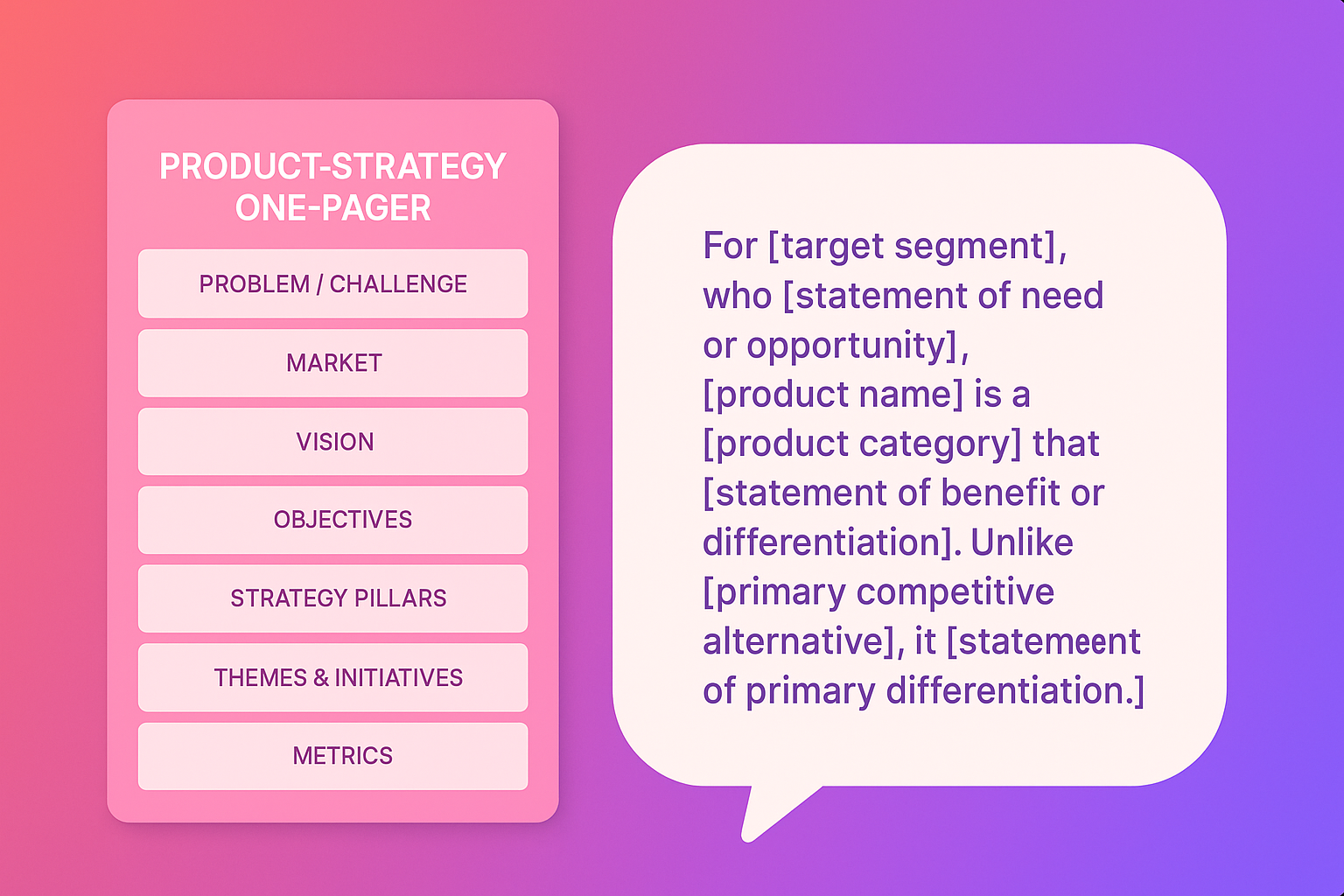
Create a one-pager
– Top: Problem / Challenge and Market
– Middle: Vision, Mission, Objectives, Strategy Pillars
– Bottom: Themes, current initiatives, key metricsAnother great way to create a one pager and make ir more rememberable is to create a Product Strategy using the Elevator Pitch Framework
Craft an elevator pitch for the product
Who it’s for
What problem it solves
Why it’s different
Why it matters now
Example structure you can adapt:
For [target segment]
who struggle with [key problem],
our product is a [type of product]
that helps them [primary benefit].
Unlike [main alternatives],
we [key differentiator, how we win],
which means [business impact + user value].
Tell the cathedral story often to help teams connect their daily work to the bigger “Why”. Use the product strategy structure to show how features connect to outcomes.
Final Thoughts: Product Strategy as a Daily Tool, Not a Static Document
For product owners and product managers, a great product strategy is:
Rooted in business strategy
Obsessed with customers and continuous UX learning
Clear on why, what and roughly when
Explicit about how we will win
Connected to OKRs, roadmaps and day-to-day work
Reviewed and refined often enough that it feels alive
Use it to:
Say “no” to work that doesn’t connect up the chain
Say “not yet” when timing is wrong
Say “yes” with confidence when something clearly supports your path to winning
If you can walk into any team space, point at a feature and explain in 30 seconds how it connects back to your product and business strategy, you’re doing product strategy right.