I See the Whole Thing First. Then I Build It Until It Works.

Richard Kårström
Lead Designer
On merging solutions, directing an AI, killing darlings, and why the design eye is now the whole product.
Last week I shipped a spell battle for a slot game that people keep calling AAA. A knight, a fly mage across a swamp, four spells with real odds, a plate of gold that grows every time you win and falls off the table when you lose. The platform decides the outcome. I decided everything a player sees, hears and feels.
I want to write about how I work, because the AI conversation is stuck on the wrong question. The question is not whether a machine can generate. It is whether anyone in the room can see.
I see the whole scene before any of it exists
I do not start with a feature list. I start with a picture that already moves. The knight in the foreground, the mage far across the water, the weather between them, the trunk and the reeds framing it, the gold and the spells laid over it all. I can see the depth, where the light comes from, what is sharp and what is soft, and where the eye should land in the first second.
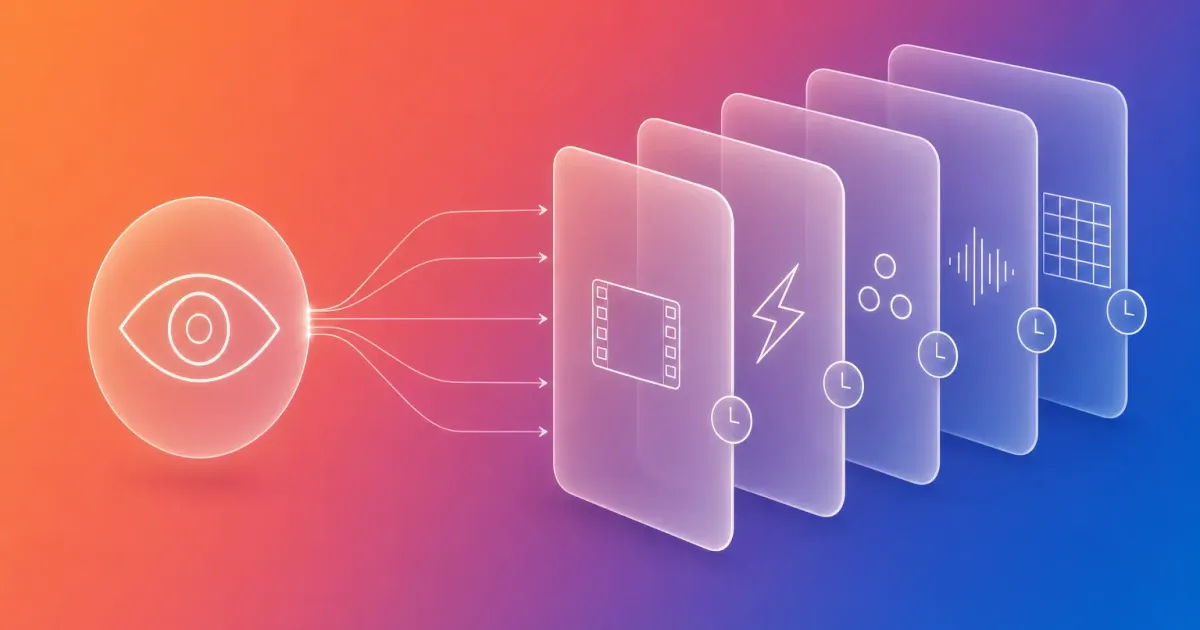
And I can see it in time. The arm comes out, the bolt leaves the palm, it crosses the pond, it lands, the mage lights up from inside, the gem lights, the gold rises. Every one of those is its own little machine, nested inside the next, and each one has a clock. The scene is fluid or it is not depending on how the clocks line up.
Most of my attention goes to the seams between those machines. That is where an experience either flows or falls apart, and it is the part nobody notices when it is right.
I merge solutions that were never meant to meet
The thing I do that is hardest to put on a CV is this: I look at a problem and see which five different disciplines it actually belongs to, and then I make them one thing.
The characters in that scene are filmed. Real footage, shot on green, cut out and dropped into a game as if they were drawn for it. The spells are not footage, because footage cannot follow a moving hand. They are generated live. The light that a spell throws is neither, it lives inside the character's own image so it sits in the body rather than on top of it. The swarm you hear is not a recording, because no recording sounded like a swarm, so it is synthesised. The layout is ordinary web layout. The dials I tune it with are a panel I built into the game itself so I could adjust the scene while it was running.
None of those on its own is remarkable. Each has a specialist who does it better than me. What I bring is knowing which one to reach for, where their edges are, and how to make them hand off to each other so a player experiences one scene and not five techniques. Film where film wins. Generation where generation wins. Sound built from scratch where samples fail. And the judgement to put the boundary in the right place.
That is composition. It is the same skill whether the material is pixels, motion, sound or code.
The spells are where the eye does the work
Four spells, and the brief I gave myself was that each had to be a different kind of matter, not a different colour of the same blob.
The venom bolt became lightning that wraps itself round its own path, crackling and re-forming faster than you can follow, reaching all the way to the mage before its tail lets go and snaps in after it. The swarm became a column of fireflies that scatter on impact. The leech became a pillar with real wriggling leeches thrown off it into the water. The mire became smoke, a tornado that stretches across the pond and whips its tail in behind.
And when the mage answers, his answer is flies. A swarm that rides his bolt, then boils over the knight, in front of him and behind him at once, buzzing like a swarm because I refused to accept anything that buzzed like a horn.
Every one of those started as a sentence in my head. Every one went through several versions that were wrong in ways only an eye can catch. The bolt that looked like the mire in another colour. The tornado that was a still image. The tornado that was a solid cone, when a tornado is never solid. The flies that flew backwards. The wings that were upside down and attached to nothing.
I could see every one of those problems in under a second. That is the job.
I kill darlings fast, because I can already see the replacement
Designers are supposed to fall in love with their work and then struggle to let go. I do not struggle, because the version in my head is always clearer than the version on the screen.
The first fly mage had beautiful wings in the footage. They could not be cut out cleanly. I cut them off the character and rebuilt them behind him. The first venom bolt was a liquid beam I liked. Gone. Two tornadoes I liked. Gone. Explosions that looked like cartoons. Gone. A rain of coins across the pond that was genuinely fun to watch. Gone, because a heap growing from underneath tells the player the story and the rain did not. A whole week of footage shot on grey. Reshot on green.
None of it hurt. When you can see the destination, the wrong turns are just wrong turns.
I did not type most of the code
An AI did, with me directing every frame.
People get this backwards. The value was never the typing. The value was knowing that the bolt had to leave from under the palm and not above it, that the flies were flying backwards, that the buzz was a horn, that the tornado was too wide at the base. The tool could not see any of that. It could build what I described, show me, and build it again when I said no.
We went through the flies six times. The wings four. The tornado five. Each pass took minutes instead of days. That loop is the whole story. Vision, build, look, correct, build. The speed changed. The judgement did not.
AI slop is what you get when nobody in the loop can see. Fluent and dead. Hand it the wheel and you get the average of everything it has ever read. Keep the wheel and you get your idea, faster than you have ever had it.
Why this makes a good designer more valuable, not less
People keep asking whether AI will take the designer's job. I have spent a week with the best model I can get, building the most demanding scene I have ever built, and the answer from the inside is plain. It took the typing. It did not take one decision.
A model can make a lightning bolt. It cannot know where the bolt has to leave from, what it has to wrap round, or where it has to land, because that is not in any prompt. It is in the eye. A model can make a tornado. It made five. Four were wrong in ways it could not see. A model can make a fly. It cannot tell that the fly is flying backwards, because it has never watched one.
Direction is seeing the gap between what came back and what you meant, naming it precisely, thirty times an hour, without losing the picture of the whole.
Composition is holding nine layers and a dozen clocks in your head at once and arranging them so a player never sees a seam.
Fine-tuning is the difference between a cone and smoke, between a horn and a swarm, between a shine that washes the whole plate and a shine that touches only the gold.
None of that is the model's job. All of it is mine. The model made the distance between my eye and the screen shorter than it has ever been, and that is exactly why the eye is now the whole product. Anyone can generate. Fewer people can see. Fewer still can hold a complex scene together while cutting the parts of it they love.
So no, a good designer is not going anywhere. The designer who could not direct, compose and fine-tune was already being replaced, by the one who could. AI just made the difference visible.
Navigating to a playable end
What I am proud of is not any single effect. It is that something this complex, a live platform deciding outcomes, filmed characters, generated spells, a coin economy, a death, a victory ladder, and the tools to tune all of it, ended up as one fluid, playable scene. A player starts it and finishes it without ever seeing a seam.
That is the job. See it whole. Choose the tools. Merge them. Wire the clocks. Cut what does not serve it. Keep going until it works.
The tools got faster. The seeing did not get easier. And the seeing is the part that was never for sale.

Richard Kårström
Richard doesn't just understand UI/UX; he excels at leading and executing high-quality design work, mentoring others in the field, and bridging the gap between strategic design goals and tangible, user-friendly products.
More Articles
Luminbrane
Luminbrane is a boutique consultancy firm dedicated to building digital products that last. We don't just write code; we partner with you to solve core business problems.
Whether you need deep-dive Postgres consultancy to stabilize your infrastructure, or a cross-functional team to handle Development, Design, UX, and Product Management, Luminbrane is your partner in navigating the digital landscape.
Learn More