 Christmas Calendar from Portico Play: 24 doors, 24 games, 1–24 December · 1–24 DecSee the calendar

When an app takes a day to build, what should it cost?

Marcus Adolfsson
Founder
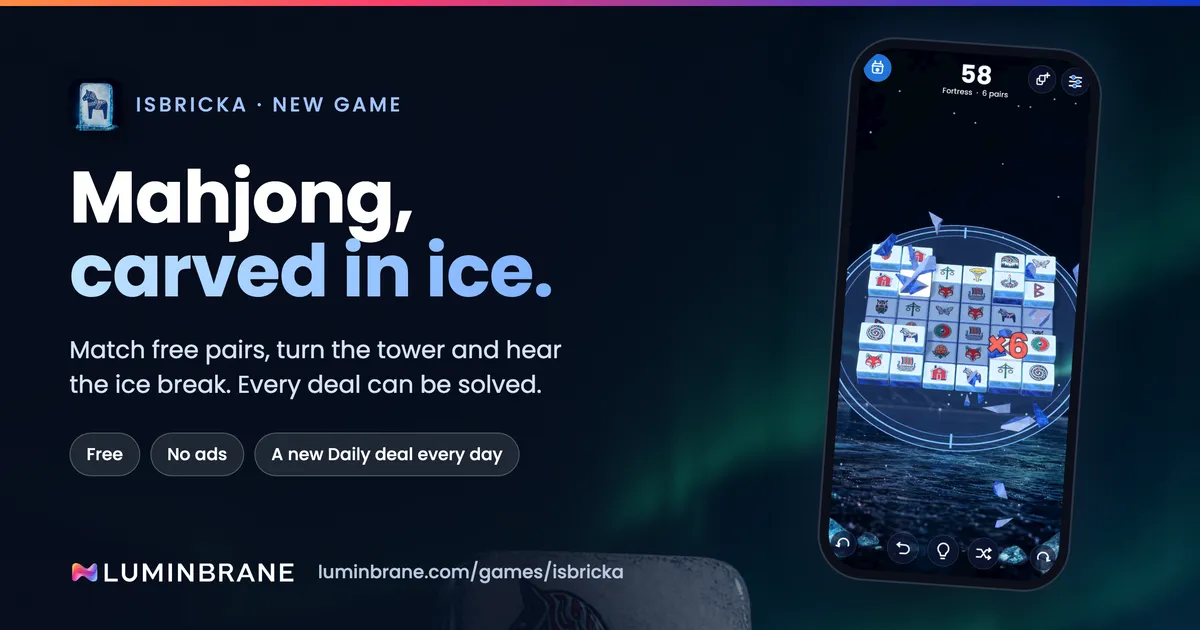
Just after midnight on a Saturday, I made the first commit to a new game. By breakfast it was on my phone through TestFlight. By the afternoon it had screenshots, a store listing and review notes. We sent it to Apple on Sunday, and on Monday morning Isbricka, a mahjong solitaire carved in ice, was live on the App Store.
I still find that a little hard to believe. A few years ago a game like this would have been a project of months. Now it's a weekend, built by me and our team of agents, with Mimmi testing on her phone from the sofa.
It raises a question I keep coming back to: if an app takes a day to build, what should it cost?
Pricing used to start with the hours
For most of my career, pricing started with cost. You counted the months a team would spend, added the design work and the testing, and worked out what each download had to bring in to pay for it all. The price followed the effort.
That reasoning falls apart when the effort gets this small. The development cost of Isbricka is close to nothing, so if price followed cost, the game would be free almost by definition. But that only tells you what the app cost us. It says nothing about what it's worth to the person playing it.
What is still scarce
When building gets cheap, other things get relatively expensive:
Attention. The App Store already has more apps than anyone could ever look at. Being found is now the hard part, not being built.
Trust. People have learned that "free" often means ads, tracking or a paywall halfway through level three. A game has to earn the benefit of the doubt.
Taste. Tools can now write the code, but someone still has to decide what feels calm, what reads well at phone size and what to leave out.
A reason to come back. Plenty of apps get downloaded. Far fewer get opened again the next day.
None of these is solved by charging money. Charging too early can make all four worse.
Why we started with free, and no ads
Isbricka is free. There are no ads, no purchases and no account, and it collects no data about the player. That was a deliberate choice, for three reasons.
First, ads would break the thing we made. Isbricka is meant to be calm. An advert between deals is the opposite of calm, and it's what most people expect from a free mahjong game. Leaving them out is how we stand apart.
Second, we don't yet know what people value. Maybe it's the Daily deal and the streak. Maybe it's putting their own photos on the tiles, or the calm of Rack mode. Until we see what people come back for, any price would be a guess.
Third, our running costs really are small. Apple's developer program is 99 USD a year, Google charges 25 USD once, and the game makes no network calls, so there are no servers to pay for. We can afford to learn first.
When we would charge
Free is where we start, not where we have to stay. I think a small game earns the right to charge once it offers more than a first impression: more layouts, new tile sets, new ways to play, enough depth that someone opens it every evening for a month.
When that day comes, these are the rules I want us to keep:
Charge for depth, not for relief. No timers to skip, no lives to refill, no pay-to-win. If the game has to annoy you before you'll pay, the price is wrong.
One honest price over a subscription. For a small game, a one-time unlock or a content pack feels fairer than a monthly charge.
The Daily stays free. Something everyone plays together shouldn't sit behind a paywall.
No surprises. Whatever we sell, you should know exactly what you get before you tap Buy.
The store fees also help a small studio here. Both Apple and Google take 15 percent rather than 30 from developers who earn under their small-business thresholds, so a modest price goes further than it used to.
Price the value, not the hours
What I've learned from this weekend is that cost is no longer a useful anchor for pricing an app. When anyone can build fast, the hours behind an app tell people nothing. What still matters is whether it makes someone's evening a little better, whether they trust it, and whether they come back tomorrow.
So we're starting with free and with care, and we'll charge when there's enough there to be worth paying for.
If you try Isbricka, I'd love to hear what you'd pay for, or whether you'd rather it stayed exactly as it is.

Marcus Adolfsson
Founder of Luminbrane. Decades in product development: General Manager of Derivco Sweden for eight years and Director of Product at Derivco Sports for six, after Head of Product and Product Owner roles in gaming.
More Articles
Luminbrane
Luminbrane is a northern iGaming innovation lab in Stockholm. We build Pitbot.AI, AI player support, and Portico Play, branded and compliant games, for regulated casino and sportsbook operators.
The same team works on your product too: product strategy, UX, UI and brand, architecture and AI engineering, and delivery.