 Christmas Calendar from Portico Play: 24 doors, 24 games, 1–24 December · 1–24 DecSee the calendar

The office has wheels now: running Luminbrane from the road

Marcus Adolfsson
Founder

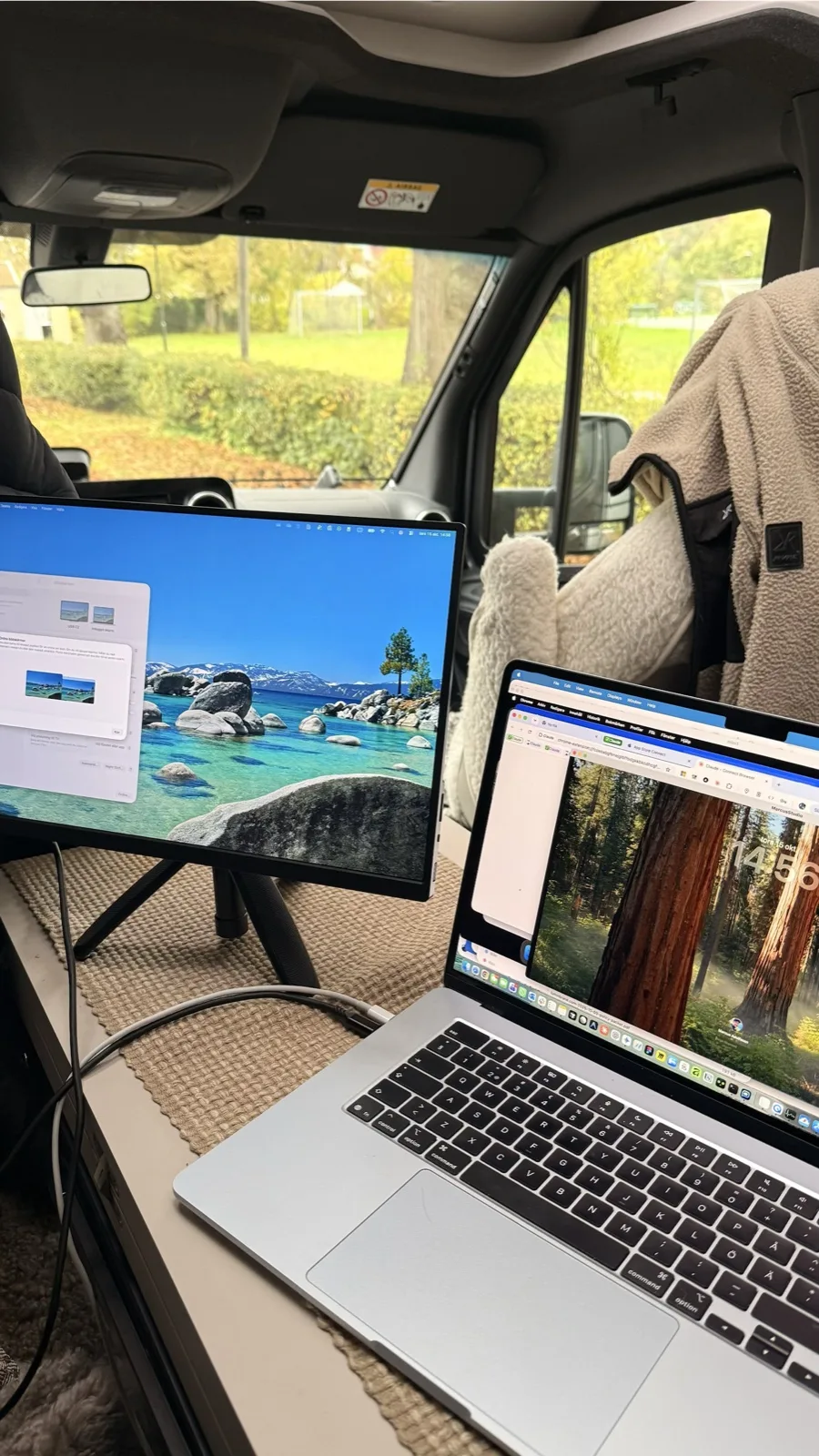
This afternoon I am writing from the cab of our RV. The laptop is on the table, a second screen is propped up next to it, and outside the windscreen the leaves are turning yellow on a football pitch I could not name. Somewhere in the cloud, a team of agents is working through the backlog. Somewhere else, the rest of the team is doing the work they are best at. I honestly had to think for a second about which town we are parked in.
That is the best compliment I can give the way we work.
A follow-up to the whiteboard
A couple of weeks ago I wrote about how we built our own whiteboard, and about how I have believed in remote work ever since I read Jason Fried and David Heinemeier Hansson's Remote: Office Not Required back in 2013. I said then that structure is what makes the freedom work.
This post is the other half of that story. The whiteboard is the structure. This is what the freedom looks like.
Four people, a team of agents, one Mac and two remote machines
Luminbrane is four people. We build software for our clients and our own products, among them Pitbot, which helps iGaming support teams answer players with AI drafts while the team stays in control of what gets sent, and Portico Play, a game studio for branded campaigns: spins, scratch cards, quizzes and polls that people actually want to come back to.
Alongside the four of us works a team of AI agents, and they have names. Otto captures ideas into the backlog. Iris is our product manager colleague who triages and plans. Bob writes the code. Reala ships releases. Maeve answers support questions and keeps our documentation tidy. Argus watches the alerts. Selma drafts sales outreach, and nothing goes out without a human saying yes.
Every afternoon at four, Iris suggests what Bob should build overnight. I pick from her shortlist, Bob works through the night, and in the morning I test what he made with a coffee in my hand. We call it Night Shift, and it still makes me smile every single morning.
All of it, the whole company, is run from one Mac and two remote machines. Not from a headquarters. From wherever the Mac happens to be.
Trust is the whole thing
People sometimes ask how I know everyone is working when I cannot see them. The honest answer is that I do not look. I look at what we ship.
That is what trust means in practice. I trust the four people on this team completely, and they have earned it many times over. I am genuinely proud of them. They take ownership, they care about the details nobody would notice, and they build things that are better than what I would have built alone. When one of them disappears for a run in the middle of the day and comes back with the answer to a problem we had been stuck on all morning, that is not a lack of discipline. That is the point.
The agents need trust too, but a different kind. You do not trust an agent because it is clever. You trust it because you have built the guardrails so that you can: every change goes on a branch, every plan is approved before it is built, every release is reviewed, every outgoing email waits for a human. Trust in people is given. Trust in agents is designed. Both let me let go.
What the research says
I am not alone in believing this works, and it is not just a feeling. Some of the best research we have points the same way:
In a randomised trial with 1,612 employees at Trip.com, published in Nature in 2024, two days a week working from home cut quit rates by a third, with no effect on performance reviews or promotions over the following two years.
An earlier experiment by Nicholas Bloom and colleagues at the same company found that working from home led to a 13% increase in performance, along with lower staff turnover.
When US patent examiners moved from working from home to working from anywhere, their output rose by 4.4% with no increase in rework, according to a Harvard Business School study in the Strategic Management Journal.
Gallup found that six in ten fully remote employees would be extremely likely to look for another job if their flexibility were taken away.
To be fair, it is not magic. A study of more than 10,000 IT professionals who were sent home overnight during the pandemic found that productivity per hour fell, mostly because communication and coordination got harder. That matches our experience exactly. Remote work without shared structure turns into drift. That is why we built the whiteboard, and why our agents write everything down.
Having fun is not a side effect
I want to say this plainly: we have fun. Building Pitbot is fun. Watching a Portico Play campaign go live and seeing people actually play is fun. Waking up to find that Bob has fixed three bugs overnight, and that one of his fixes is better than mine would have been, is fun in a slightly humbling way.
I do not think good work and enjoying your work are separate things. The best things we have built came out of weeks when we were having a good time.
Almost not knowing where you are
We live and work from an Adria Coral Supreme. Some weeks it is parked at home. Some weeks it is a forest, a lake or a car park next to a football pitch. The work looks the same from all of them, and that is exactly what makes the life around the work so different.

I share the RV with Mimmi, my girlfriend, and our dog Jana. Jana is an Australian Cattle Dog with strong opinions about balls, dental sticks and the motorhome, and she has her own Instagram, which is frankly more popular than anything I post.

The part that matters most
Here is the thing I have come to understand most clearly, out here.
The time I get with Mimmi is precious. Not "nice to have". Precious. Lunch together on a Tuesday. A walk with Jana between two meetings. Watching the light change over a lake we found by accident the night before. These are not breaks from a life that happens somewhere else. They are the life.
Remote work did not give me more time. It gave me back the time I used to throw away: on commutes, in meetings that only existed because we were in the same building, in being present instead of being useful. And it gave that time to the people I love.
So this is a thank-you, really. To the four people at Luminbrane, who make all of this possible and who do work I am proud to put my name next to. To a team of agents who quietly work the night shift. And to Mimmi and Jana, for making wherever we happen to be parked feel like home.
If you are curious about what we build, have a look at Pitbot and Portico Play. And if you are wondering whether a small team can run a real company from the road: yes. You just have to trust each other.

Marcus Adolfsson
Founder of Luminbrane. Decades in product development: General Manager of Derivco Sweden for eight years and Director of Product at Derivco Sports for six, after Head of Product and Product Owner roles in gaming.
More Articles
Luminbrane
Luminbrane is a northern iGaming innovation lab in Stockholm. We build Pitbot.AI, AI player support, and Portico Play, branded and compliant games, for regulated casino and sportsbook operators.
The same team works on your product too: product strategy, UX, UI and brand, architecture and AI engineering, and delivery.