
We built our own whiteboard in less than a day. Now you can use it too

Marcus Adolfsson
Founder
Try it yourself
Luminbrane Whiteboard is free for your team. Sign up with your email address, make a board and invite the people you work with.
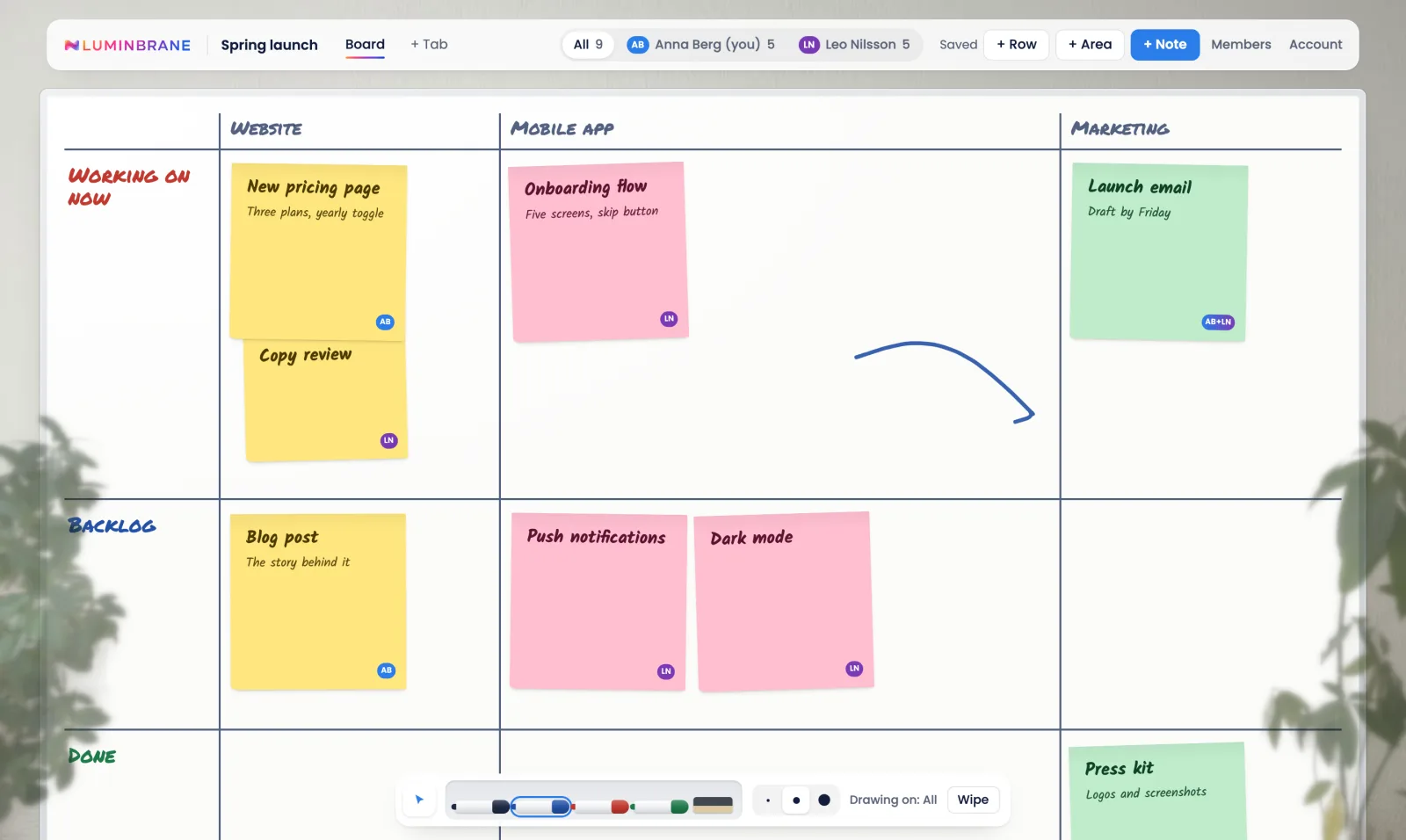
Luminbrane Whiteboard is a shared post-it board for small teams, and as of this week anyone can use it, for free. It started as our designer's answer to a very ordinary problem: we needed a better structure for the work we had going. In less than a day he had built it. Now we open it every single day.
It started with a designer who wanted structure
Richard, our designer, wanted a clearer picture of what we were all working on. Not a ticket system. A wall: rows for where things are, areas for what they are about, and post-its you can pick up and move.
So he built one. In less than a day he had a working board with tabs, areas, sub-notes that stack under their main note, a Parked strip for things that have fallen off the plan, and a marker for drawing arrows and circles around it all. He even hung it on an office wall, plants in the foreground and all. It was beautiful, and it was exactly what we needed.
That same evening we turned it into a proper multi-user app, with invitations, roles and secure sign-in. We have used it daily ever since.
Why not Miro, FigJam, Linear or Jira?
We looked, of course. They are all great tools, and we use some of them. FigJam and Miro are wonderful infinite canvases for a workshop. Linear is the best issue tracker we have used, and our engineering backlog lives there. Jira can model just about any process a large organisation can think up. Trello, Asana, Notion and Monday all have loyal fans, for good reasons.
For what we needed, though, every one of them was overkill. We did not need an infinite canvas, custom workflows, sprints, story points or permission schemes. We needed one shared wall that showed, at a glance, what each of us was doing. And per-seat pricing adds up quickly for what is, in the end, a set of post-its.
So we built what we needed, and nothing more.
I have believed in remote work since I read Remote
In 2013 Jason Fried and David Heinemeier Hansson of 37signals published Remote: Office Not Required. Its argument was simple: good work does not depend on everyone sitting in the same room, and a company that insists it does is usually measuring presence rather than output. I read it back then and I have believed it ever since.
That is how we work at Luminbrane. We do meet up now and then, and those days matter. But with trust between us, it does not really matter when or how we meet. Some days we are in an office. Some days the meeting is a Teams call taken while out walking or running. Other days we are working remotely, from home or from somewhere else entirely.
What that way of working does need is a common view of what we are doing. When you are not in the same room, you cannot glance at the wall to see where everyone is. A shared board is the closest thing to that wall, and it looks the same from a desk, a train or a phone on a forest path.
Structure is what makes the freedom work
Freedom without structure turns into drift. The reason we can work from wherever we like is that the work itself is well structured: we know what is in progress, what is waiting and what is done.
That idea is much older than any software. Kanban came out of the Toyota Production System, where cards on a board made work visible and limited how much was in flight at once. Dominica DeGrandis makes the same case for knowledge work in Making Work Visible: much of what slows a team down is work that nobody can see. Good project management is not about more process. It is about everyone looking at the same truth.
Whiteboard is built around that idea:
Rows for where work is: working on now, backlog, done.
Areas for what it is about: the website, the app, marketing, whatever your work divides into.
Sub-notes for the steps of a bigger task.
Parked for things that are not dead, just not now.
A marker, because sometimes an arrow says more than a status field.
What it does today
Post-its on a grid of rows and areas, with a tab per project, each in its own colour.
Drag a note to move it, drop it on another note to make it a sub-note, or drop it off the board to park it.
Draw on the board, with a layer for each person plus a shared one. Lines can hook onto notes and follow them when they move.
Drop in files up to 100 MB. Images, video, audio and PDFs preview right on the board, and your team can comment on them.
An overview that puts every tab on one screen.
Invite your team as owners, editors or viewers. Changes show up for everyone straight away.
Sign in with a code by email, a password or an authenticator app, and require two-factor sign-in for a whole board if you want to.
Hosted in Stockholm. Download your data or delete your account at any time.
Now you can use it too, for free
We built Whiteboard for ourselves, but there is nothing Luminbrane-specific about it. If you are a small team that wants one shared view of what you are doing, without the weight of a full project tool, give it a try.
It is free. Create an account with your email address, make a board and invite the people you work with. If we ever add paid plans, we will tell you in advance, and nothing will cost you money unless you choose it.

Marcus Adolfsson
Founder of Luminbrane with a passion for building great products that are loved by end users. Marcus specialises in iGaming products and has led successful product launches across multiple jurisdictions.
More Articles
Luminbrane
Luminbrane is a boutique consultancy firm dedicated to building digital products that last. We don't just write code; we partner with you to solve core business problems.
Whether you need deep-dive Postgres consultancy to stabilize your infrastructure, or a cross-functional team to handle Development, Design, UX, and Product Management, Luminbrane is your partner in navigating the digital landscape.
Learn More

